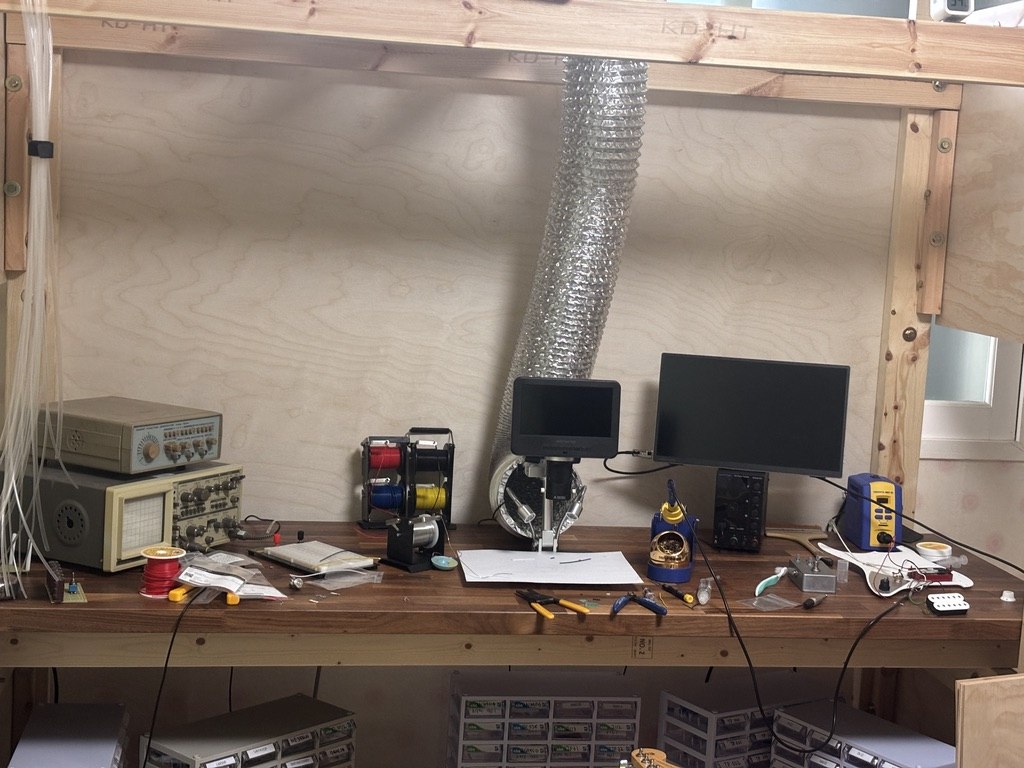
Rapid Working Workbench
Shenzhen Speed
Named after the legendary "Shenzhen speed" of hardware iteration, this is the workflow and tooling built around my own workbench to compress the distance between an idea and a working, housed prototype down to a single day.
The workflow
- Schematic in LTspice — design and simulate the circuit before any solder touches the board, catching issues on screen instead of on the bench.
- Perfboard prototype — hand-built, no PCB turnaround to wait on. Fast to build, fast to rip out and redo when the simulation didn't catch everything.
- Oscilloscope debugging — verify real-world behavior against the simulation, right at the bench, no separate test setup.
- 3D-printed housing — once the circuit works, a printed enclosure turns a loose board into something that looks and feels like a real product, same day.
Each stage hands off to the next with almost no setup time in between — the goal isn't skipping rigor, it's removing every bit of friction between one step and the next.
Parts Management
Keeping a home lab stocked with electronic parts is easy. Finding the right one without digging through bins is the hard part — and it's what actually slows the workflow above down. So the workbench includes a parts management system that runs live at sungho-parts-web:
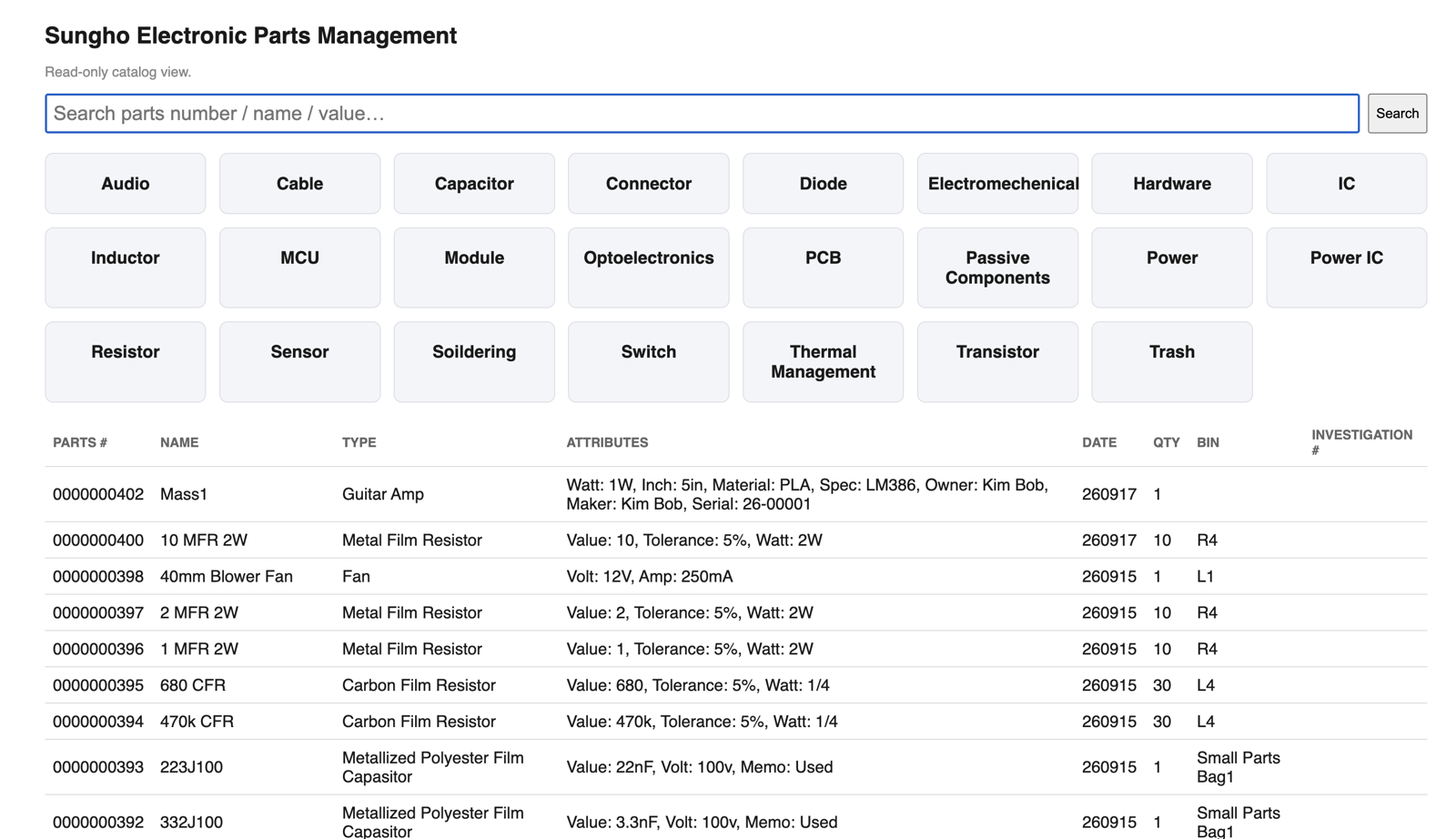
- Organized, searchable inventory — every part is categorized (resistors, capacitors, ICs, connectors, and more), searchable by part number, name, or value, with quantity and bin location tracked per entry.
- AI-driven circuit design — instead of designing a circuit and then hoping the parts exist somewhere in a drawer, the AI proposes designs using the database as ground truth for what's actually in stock.
That closes the loop between "what can I build right now" and "what do I actually have" — which is what makes the single-day turnaround above possible in the first place.